
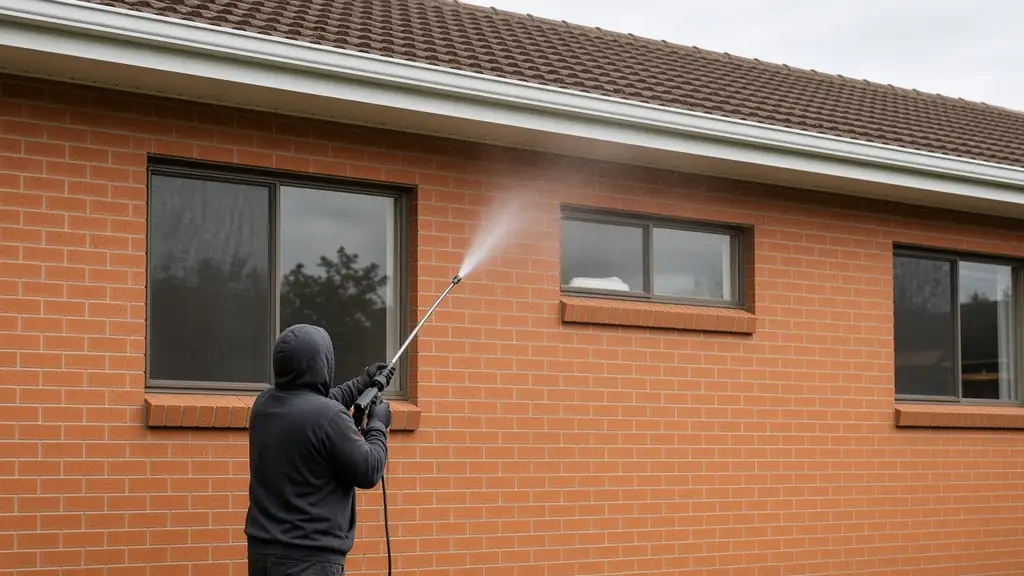
Brick-and-tile homes are everywhere in South and East Auckland. Manurewa and Papakura have plenty from the 60s and 70s. Botany and Dannemora are full of 90s brick veneer with concrete tile roofs. Howick's hillside streets have a good mix of both. Because brick is hard-wearing, a lot of owners assume the whole house can just be water blasted. Some of it can. Some of it really shouldn't be.
The brick itself
Clay brick is tough, and it can take more pressure than painted timber or plaster. But "more" isn't "unlimited". The weak point is the mortar. Older mortar, especially on 50-year-old homes, can be soft and crumbly, and a narrow, high-pressure jet will cut grooves into it. Once the joints are eroded, rain gets into the wall more easily.
Brick also isn't the dirtiest part of most houses. The lichen spots and green on the shaded side come off well with a soft wash, which kills the growth instead of blasting the surface.
The joinery and seals
This is where water blasting does the most damage on a brick house. Aluminium window frames have rubber seals and drainage holes. A high-pressure jet can drive water past the seals, and it can damage the powder coating on older frames. Timber window frames on older brick homes are even more at risk, because the paint lifts easily.
A soft wash cleans the frames, sills and tracks without forcing water anywhere.
The eaves and soffits
Most brick-and-tile homes have painted soffit linings under the eaves, often fibre-cement sheet. That's where cobwebs, black mould and spider eggs build up. High pressure up there can damage the paint and the sheet edges, and it drives water into the roof space. Low pressure and a cleaning solution is the right tool.
The concrete tile roof
Concrete tiles on a 50-year-old Manurewa home, or a 30-year-old Botany home, have lost a lot of their original surface. Water blasting strips more of it away, leaving the tile rougher and more absorbent. Lichen and moss grow back faster on a rough tile, and blasting can crack tiles and push water up under them.
That's why we clean roofs with a soft wash at low pressure, even when the walls are brick.
So what does get water blasted?
The hard, flat surfaces around the house:
- Concrete driveways and paths
- Patios and paving
- Concrete steps
- Some retaining walls
These can take proper pressure, and it's the best way to shift ground-in grime, moss and tyre marks. The pressure is still set to suit the surface, so exposed aggregate or older concrete isn't chewed up.
How a mixed job usually goes
On a typical brick-and-tile house, the order of work looks something like this:
- Roof soft washed first, if it needs it
- Gutters cleared so nothing drops onto clean walls
- Brick, joinery and eaves soft washed
- Driveway and paths water blasted last
That way, each surface gets the method that suits it, and nothing gets damaged along the way.
Your suburb
- House washing in Manurewa
- House washing in Botany
- House washing in Howick
- Roof cleaning in Papakura
- Water blasting in Auckland, for driveways and paths
Call or text 027 303 8398 and we'll tell you what your house needs.