
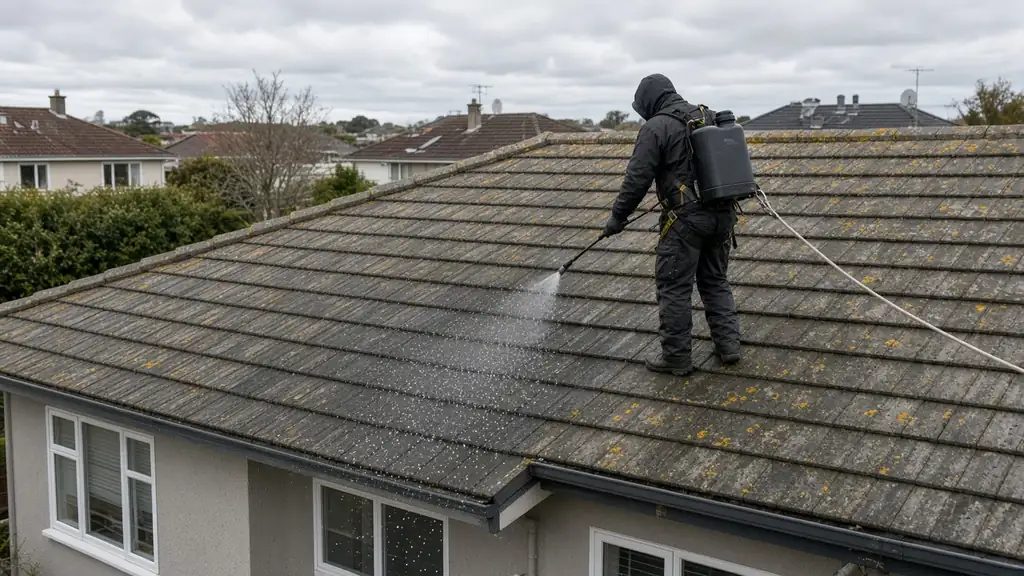
If you've moved to Upper Hutt or Stokes Valley from somewhere sunnier, the speed your roof goes green can be a surprise. A roof that was cleaned two or three years ago can already have moss along the bottom rows and lichen spreading across the shaded slope. That isn't bad luck. It's the climate.
Cold air sits in the valley
Upper Hutt is the inland end of the Hutt Valley, and it behaves like it. On clear, still nights, cold air slides down off the hills and pools on the valley floor. That's why Upper Hutt gets many more frosts than central Wellington, and why mornings are so often foggy.
For a roof, that means it stays cold and wet well into the day. Dew and frost melt slowly, and a roof that's in shade doesn't dry until the afternoon, if at all in midwinter. Moss needs moisture far more than warmth, so a roof that's damp for most of the day is perfect for it.
Stokes Valley loses the sun early
Stokes Valley adds steep sides to the picture. It's a narrow valley with bush-covered hills rising close on both sides, so the sun clears the ridge late in the morning and drops behind the other side early. Houses on the lower slopes can spend most of winter in shade. Roofs that face away from the sun hardly dry at all between June and August.
Needles and leaves feed it
Pine plantations and bush cover a lot of the hills around Upper Hutt, and Pinehaven is named for them. Pine needles land on roofs, slide into valleys and pile up along the lower edge. They hold water, break down slowly and give moss somewhere to root. In Stokes Valley, it's native leaf litter from the bush that does the same job, all year round.
What it does to your roof
Moss and lichen aren't just cosmetic.
- On concrete tiles, moss keeps the surface wet and slowly wears it down. Over many frosty winters, water held in moss freezes and thaws against the tile edges.
- On corrugated iron, moss and mould hold moisture along the laps and around the fixings, where rust usually begins.
- On every roof, moss breaks off in heavy rain and blocks the gutters.
Cleaning it properly
The safe way to clean a mossy roof is a soft wash. A cleaning solution goes on at low pressure and kills the moss, lichen and mould, then it's rinsed off gently. The roof is clean on the day.
Water blasting is the thing to avoid. It does take moss off, but it also strips the surface from concrete tiles and the paint from iron. A rougher, more porous tile grows moss back even faster, and bare iron rusts.
Keeping it off
In valleys like these, moss always comes back eventually. The best approach for most homes is:
- A full clean to get the roof back to bare
- A roof treatment every year or two, which kills new growth over 4 to 6 weeks before it gets thick
- Clearing gutters at least twice a year, so debris doesn't build up along the edges
- Trimming any branches that overhang the roof, if you can
Local pages
- Roof cleaning in Upper Hutt
- Roof cleaning in Stokes Valley
- Gutter cleaning in Upper Hutt, for pine needles in the spouting
Call or text 027 303 8398 for a free roof quote.
Quick questions
Should I scrape moss off my roof myself?
It's not worth the risk. Walking on a mossy roof is slippery, scraping can damage tiles and paint, and the roots stay behind so it grows back. A soft wash or a treatment kills it properly.
Will zinc strips stop moss?
They can help near the ridge on some roofs, but they don't stop growth on shaded lower slopes. They're not a substitute for cleaning a roof that's already green.