
South Auckland doesn't get many storms that stop the city, but when one does roll through, it tends to find every weak spot on a house. The gutters are usually the first thing to give it away. Water pours over the edge, a downpipe gurgles and then goes quiet, and a puddle appears somewhere it's never been before.
The good news is that you can learn a lot from the ground, in the first day or two after the rain stops.
Walk around the house while it's still wet
The best time to look is the morning after. Things are still damp, so the evidence is easy to read. Take a slow lap of the house and look at three things.
The ground under the gutter line. If there's a trench dug into the garden bed, or bark and mulch washed across the path, water came over the top of the spouting. On a lot of Manurewa and Papakura homes with concrete paths right up against the house, you'll see a line of dirt splashed up the bottom of the wall instead.
The walls and fascia. Fresh dark streaks running down from the gutter, or a wet fascia board a day after the rain stopped, both mean water spilled over the back or front of the gutter.
The bottom of each downpipe. Is the ground around it wet, the way it should be? If one downpipe outlet is bone dry while the others are soaked, that pipe is blocked somewhere above.
Why storms catch South Auckland gutters out
In Manurewa and Papakura a lot of the housing is from the 1950s to the 70s, with concrete tile roofs that have been shedding grit and lichen into the spouting for decades. The trees are mature too, especially around Hillpark, Totara Park and the Red Hill side of Papakura. Over a year, that adds up to a thick layer of sludge sitting at the low points. Light rain gets through it. A storm doesn't.
Takanini is a different story. A lot of the houses are newer and the gardens are young, so people assume the gutters are fine. But fine dust from years of nearby building work, plus grit off the roof, settles into the spouting and turns into mud. Takanini is also flat and low, so when a gutter overflows, the water has nowhere to go but straight down beside the house.
The jobs a storm makes urgent
Some things can wait until the next scheduled clean. Some can't.
- Water coming inside, through a ceiling or down the inside of a wall, usually means a box or internal gutter has overflowed. Get that looked at straight away.
- A downpipe that's come away from the wall or split at a joint will dump water against the house every time it rains.
- A sagging section of spouting after a storm is often full of wet debris. The weight will keep pulling on the brackets.
- Gutters full to the brim with leaves and sludge, visible from an upstairs window, won't cope with the next front either.
What a gutter clean actually involves
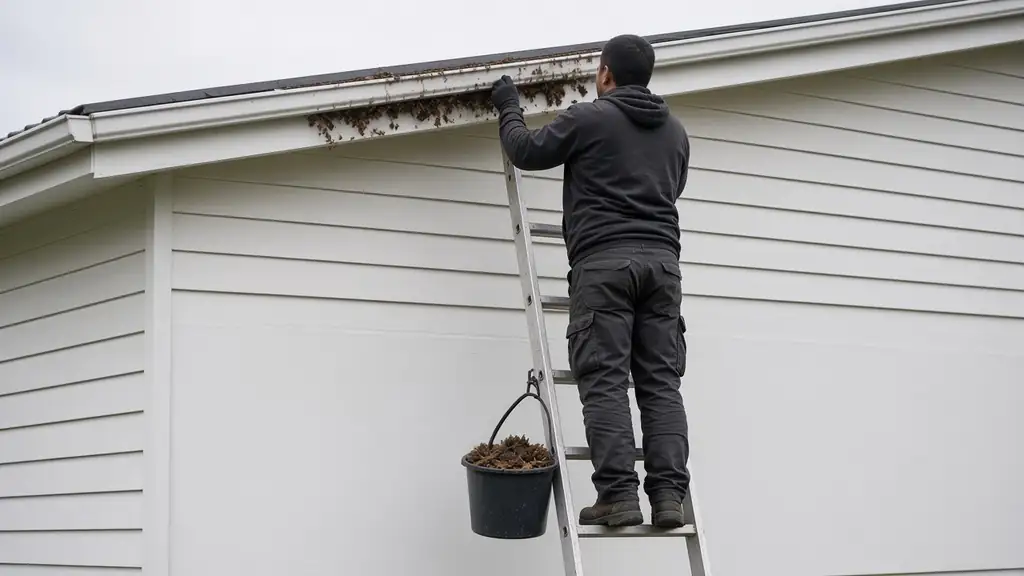
When we clean gutters in South Auckland, everything is taken out by hand, bagged and removed from the property. Each downpipe is checked and cleared, and then the whole system is flushed with water so we can see it drain. If a bracket has let go or a joint is leaking, we'll show you, so you can get a roofer or spouting specialist to fix it.
Most houses take one to three hours. You don't need to be home.
Getting ahead of the next one
Twice a year suits most South Auckland homes: once after the autumn leaf drop, and once in spring. If you've got big trees over the roof, or the house backs onto a reserve, a third clean in summer is worth it. And if the roof is covered in lichen, cleaning it means far less grit ends up in the spouting in the first place.
If you're in one of these suburbs, these pages cover what's different about each:
- Gutter cleaning in Manurewa
- Gutter cleaning in Papakura
- Gutter cleaning in Takanini
- Roof cleaning in Manurewa, if the grit is coming off old tiles
Or call or text 027 303 8398 and tell us your street. Quotes are free.
Quick question
Is it safe to check my own gutters after a storm?
Look from the ground first. Most of the signs are visible without a ladder. If you do go up, wait until the roof and ladder are dry, have someone foot the ladder, and stay off the roof itself.